How to Plan a Groundbreaking Ceremony: Program and Checklist
- Author: Ribbon Cutting Desk Editorial Team
- Checked by Ribbon Cutting Desk Editorial Team
- Most recently reviewed
- Posted
- In Groundbreaking
To plan a groundbreaking ceremony, first agree the date, site and safety rules with the contractor and landowner. Then set the guest list and speakers, mark a safe ceremony area with access and parking, write a short program and prepare a weather fallback. Allow about six weeks for a simple event, longer when permits apply.
Section of: Groundbreaking Ceremony: Meaning, Steps and Ideas
General information, not legal, insurance or safety advice. Follow the site safety officer and your local rules.
Cue-checked by the Ribbon Cutting Desk team: each fact above was matched to a source this page cites.
A groundbreaking is planned around the site, not around the stage. This page walks through the steps in the right order. For the overview of what the ceremony is, read the groundbreaking pillar guide; for sample words, the groundbreaking speech page; for the invitation, the groundbreaking invitation page.
What are the steps, in short?
Plan in seven steps: contractor and landowner, date, guests and roles, site and safety, program, weather, and checklist. Do them in this order because each depends on the one before.
- Talk to the contractor and landowner.
- Fix the date and time.
- Build the guest list and assign roles.
- Plan the site, access and parking.
- Write the program.
- Prepare the weather fallback.
- Work the checklist.
What should you check with the contractor and landowner first?
Start with them, because they control the site. Ask these questions in writing and keep the answers.
- Which days and hours can the site be set aside for guests?
- Where can guests stand, and where must they not go?
- Do guests need hard hats, vests or sturdy footwear, and who supplies them?
- Who is the site safety officer and who briefs guests?
- Will equipment be paused or kept away during the event?
- Is a permit needed from the city, and who applies?
OSHA describes construction as a high-hazard industry, citing hazards such as falling from rooftops, unguarded machinery and being struck by heavy construction equipment. That is why the answers to these questions come from the contractor, not from the organizer.
Who do you invite and who does what?
Invite guests of honor first, then the wider list. Use the same layers as any ceremony: guests of honor, the project team, the community, and any press.
Assign names to these roles:
| Role | Job |
|---|---|
| Host / master of ceremonies | Runs the program and gives the cue |
| Site contact | The contractor’s representative; controls access |
| Greeters | Check in guests, point to the ceremony area, hand out any required items |
| Boundary helpers | Stand at the edges of the marked area |
| Ceremony party wrangler | Gathers the group for the soil turn |
| Photographer | Captures the key moments |
| Weather lead | Watches the sky and calls the fallback |
Keep the ceremony party small, three to eight people, and include someone from the team doing the work.
How do you plan site safety, access and parking?
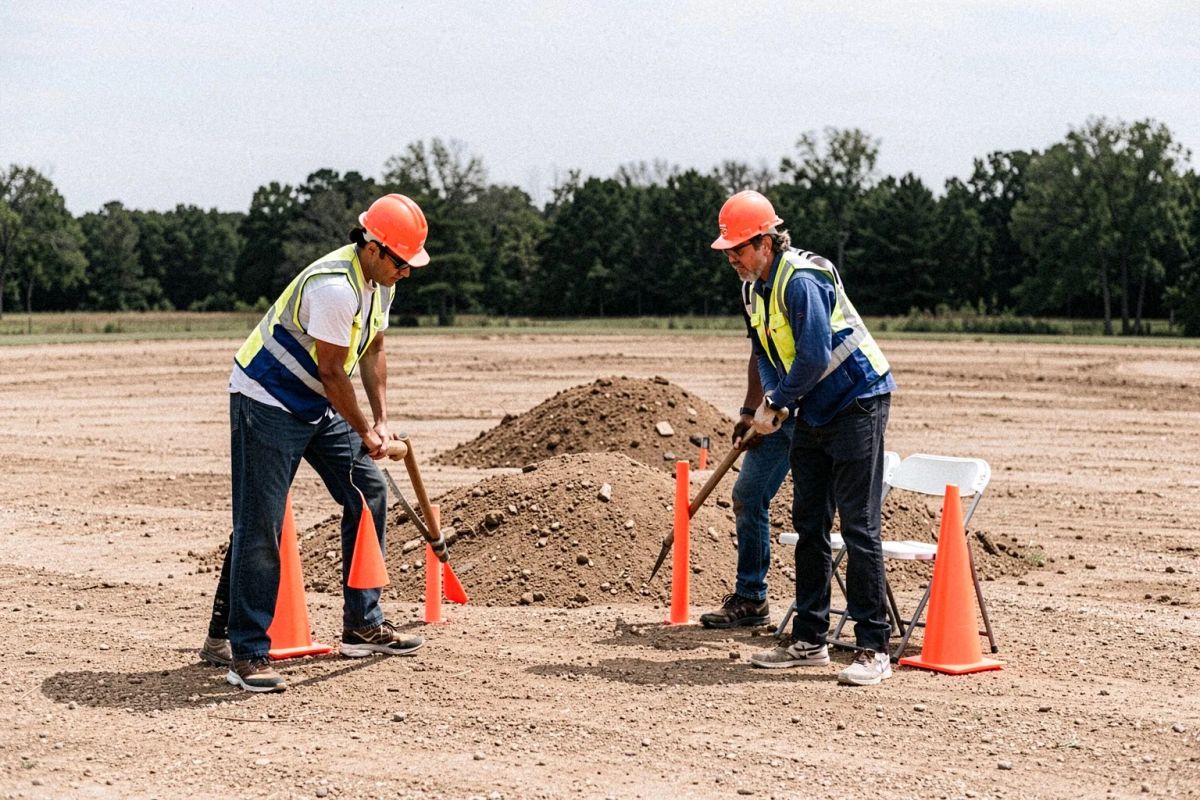
Mark a ceremony area that is away from active work, has level ground and has a clear route in. Use cones or tape and put a helper at each boundary. Brief guests at the start in two sentences: where to stand and where not to go.
Practical points:
- Route. Make the path from parking to the ceremony area as smooth as you can, for wheelchairs, walkers and strollers. If the ground is soft, say so in the invitation.
- Parking. Mark where guests may park, away from construction traffic.
- Seating. A few chairs for guests who need them.
- Sound. A portable microphone, tested at the site.
- No guest uses any equipment. The symbolic act is a hand action in the marked area.
- Access help. The ADA says covered entities must communicate effectively with people who have communication disabilities and generally cannot require a person to bring their own interpreter. Say in the invitation how to request an interpreter or other help.
What does an example program look like?
This is an editorial example of about 25 minutes from welcome to close. Adjust it to your site.
| Minute | Step |
|---|---|
| Before 0 | Arrivals, check-in, any required items handed out |
| 0 | Welcome and safety note |
| 3 | Thanks and introductions |
| 6 | Remarks from the owner or project lead |
| 10 | Remarks from the partner or official |
| 14 | Contractor or design lead: what is being built |
| 17 | Ceremony party lines up |
| 19 | Countdown and soil turn |
| 20 | Applause and photos, group shot |
| 23 | Thanks and invitation to refreshments or display |
The ceremony program builder turns your speakers and times into a printable program.
What is the checklist, week by week?
Use this as an editorial example for a simple event; start earlier when permits apply. The City of Orlando, for example, says a special event permit is required when more than 100 people attend an event on city property, with applications due at least 60 days ahead. Other cities differ.
About six weeks before
- Agree date, site and safety rules with the contractor and landowner.
- Ask your city about permits.
- Confirm guests of honor.
About three weeks before
- Send the general invitation, with safety and dress notes and the access contact.
- Confirm speakers, ceremony party and roles.
- Decide on required items and who supplies them.
About one week before
- Walk the site with the contractor and mark the area.
- Test sound. Plan parking and signs.
- Confirm the weather fallback and the decision-maker.
- Print the program.
The day
- Set up early, hold a briefing, check the boundary.
- Greet guests of honor.
- Start on time, give the safety note and keep to the program.
What is the weather and fallback plan?
Name a covered fallback and a person who calls it. The National Weather Service says that if you hear thunder you are likely within striking distance of the storm, and there is no safe place outside when thunderstorms are in the area. Choose a call time, such as an hour before, and say in the invitation what happens if it moves. For light rain, decide in advance whether to proceed, shorten the program or move indoors.
The ideas page includes an indoor version for bad weather, which is worth reading when you write the fallback.
People also ask
Who has to approve the date and site?
The landowner and the contractor both need to agree, and the owner or project lead decides the final date. If the site is on public property or a street is affected, your city may need to approve it too. Ask the contractor what days and hours the site can be set aside for guests, and get the answer in writing.
Do guests enter the work area?
Usually only a marked ceremony area, not the active work area. The contractor and site safety officer decide where guests may stand and what they must wear. Many ceremonies are held at the edge of the site or in a cleared corner. If guests will walk on uneven ground, say so in the invitation.
How long should the program be?
About 20 to 40 minutes in total is a reasonable editorial example, with a short formal program of 10 to 20 minutes. Outdoor, open-site events feel long quickly, so keep remarks tight. Build in time for check-in and any safety briefing before the welcome, and for photos after the soil turn.
Do we need a rain plan?
Yes. Name a covered fallback and a person who decides. The National Weather Service says there is no safe place outside when thunderstorms are in the area, so a storm means moving people indoors, not waiting it out in a tent. Decide the call time in advance, and say in the invitation what happens if the event moves.
What do we need from the contractor?
Ask for the safe ceremony area, any items guests must wear, who briefs guests and who supervises the boundary. Ask what equipment will be paused during the event, and who the site safety officer is. Also ask what the contractor needs from you, such as a guest list in advance. Keep all answers in writing.
Our sources
- Construction (OSHA) (osha.gov)
- Effective Communication (ADA.gov) (ada.gov)
- Lightning Safety (National Weather Service) (weather.gov)
- Events on Public Property (City of Orlando) (orlando.gov)
Related guides
- Groundbreaking Ceremony: Meaning, Steps and Ideas
What a groundbreaking ceremony is, who takes part, the typical sequence, the site-safety rules guests follow and how it differs from real construction.
- Groundbreaking Ceremony Ideas for Projects Big and Small
Groundbreaking ceremony ideas for large and small projects: classic formats, community roles, home builds, nonprofits, bad weather and safety limits.
- Groundbreaking Ceremony Invitation Wording and Samples
Groundbreaking invitation wording: what to include, formal and friendly samples, email and letter versions, site-safety and dress notes, timing and RSVP.
- Groundbreaking Ceremony Speech Examples and What to Say
Original groundbreaking speech wording: structure, welcome, why the project matters, thank-yous, the soil turn, plus 60-second and 3-minute versions.